Blog

Membrane mirrors for large space-based telescopes?

Researches create lightweight flexible mirrors that can be rolled up during launch and reshaped precisely after deployment.

Mirrors are a significant part of telescopes. When it comes to space telescopes, which have complicated procedures for launching and deploying, the primary mirrors add considerable heft, contributing to packaging difficulties.

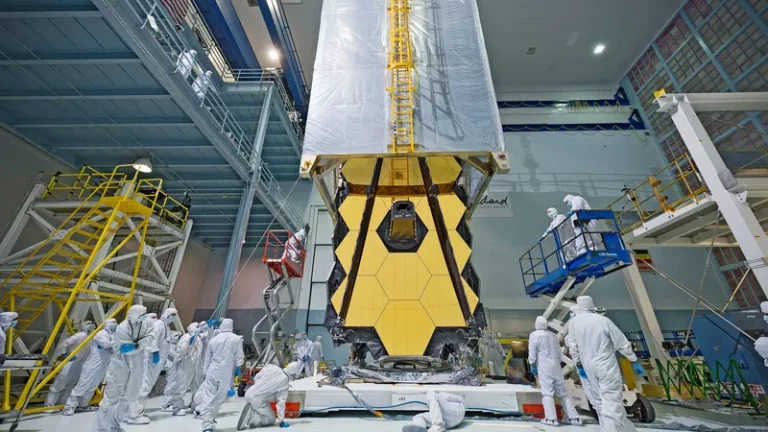
Researchers have now come up with a novel way of producing and shaping large, high-quality mirrors. These mirrors are not only thinner than the primary mirrors usually employed in space-based telescopes, but are also flexible enough to be rolled up and stored inside a launch vehicle.

Parabolic membrane mirror

The successful fabrication of such parabolic membrane mirror prototypes up to 30 cm in diameter have been reported in the Optica Publishing Group journal Applied Optics in April. Researchers not only believe that these mirrors could be scaled up to the sizes required in future space telescopes, but have also developed a heat-based method to correct imperfections that will occur during the unfolding process.

Using a chemical vapour deposition process that is commonly used to apply coatings (like the ones that make electronics water-resistant), a parabolic membrane mirror was created for the first time. The mirror was built with the optical qualities required for use in telescopes. A rotating container with a small amount of liquid was added to the inside of a vacuum chamber in order to create the exact shape necessary for a telescope mirror. The liquid forms a perfect parabolic shape onto which a polymer can grow during chemical vapour deposition, forming the mirror base. A reflective metal layer is applied to the top when the polymer is thick enough, and the liquid is then washed away.

Thermal technique

The researchers tested their technique by building a 30-cm-diameter membrane mirror in a vacuum deposition chamber. While the thin and lightweight mirror thus constructed can be folded during the trip to space, it would be nearly impossible to get it into perfect parabolic shape after unpacking. The researchers were able to show that their thermal radiative adaptive shaping method worked well to reshape the membrane mirror.

Future research is aimed at applying more sophisticated adaptive control to find out not only how well the final surface can be shaped, but also how much distortion can be tolerated initially. Additionally, there are also plans to create a metre-sized deposition chamber that would enable studying the surface structure along with packaging unfolding processes for a large-scale primary mirror.

Picture Credit : Google 

What is the mission of Helios 2?

On April 16-17, 1976, Helios-B made its closest approach to the sun, thereby setting a record for the closest flyby of the sun.

April is here and with it comes searing heat as the sun beats down heavily on most parts of India. You must be aware, however, that the sun, with its entire mass of glowing, boiling heat, is the source of all life on Earth. Our sun, in fact, influences how every object in the solar system is shaped and behaves.

Studying solar processes

This means that learning more about the sun and understanding it better has always been a priority. Apart from studying it from here on Earth, which is what we did for most of our history, we have also started sending spacecraft to explore its secrets. The Helios mission was one such mission, sending out a pair of probes into heliocentric orbit (an orbit around the sun) to study solar processes.

Following the success of the Pioneer probes, which formed a ring of solar weather stations along Earth’s orbit to measure solar wind and predict solar storms, the Helios mission was planned. While the Pioneer probes orbited within 0.8 AU (astronomical unit, mean distance between Earth and sun) of the sun, the Helios probes shattered that record within years.

A joint German-American deep-space mission to study solar-terrestrial relationships and many solar processes, it was NASA’s largest bilateral project up until then. The Federal Republic of Germany (West Germany) paid around $180 million of the total $260 million cost and provided the spacecraft, while NASA provided the launch vehicles.

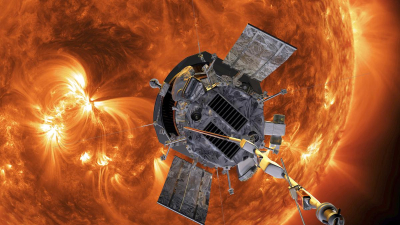
Named Helios-A and Helios-B and equipped with state-of-the-art thermal control systems, the pair of probes were renamed Helios 1 and Helios 2 after their launches. Launched late in 1974, Helios 1 passed within 47 million km (0.31 AU) of the sun at a speed of 2,38,000 km per hour on March 15, 1975. While this was clearly the closest any human-made object had ever been to the sun, the record was broken again in a little over a year by its twin probe.

Even though Helios-B was very similar to Helios-A, the second spacecraft had improvements in terms of system design in order to help it survive longer in the harsh conditions it was heading for. Launched early in 1976, Helios 2 was also put into heliocentric orbit like its twin.

Achieves perihelion

Helios 2, however, flew 3 million km closer to the sun when compared to Helios 1. On April 16-17, 1976, Helios 2 achieved its perihelion or closest approach to the sun at a distance of 0.29 AU or 43.432 million km. At that distance, Helios 2 took the record for the closest flyby of the sun, a record that it didn’t relinquish for over four decades. It also set a new speed record for a spacecraft in the process, reaching a maximum velocity of 68.6 km/s (2.46.960 km/h).

Helios 2’s position relative to the sun meant that it was exposed to 10% more heat or 20 degrees Celsius more heat when compared to Helios 1. In addition to providing information on solar plasma, solar wind, cosmic rays, and cosmic dust, Helios 2 also performed magnetic field and electrical field experiments.

Apart from studying these parameters about the sun and its environment, both Helios 1 and Helios 2 also had the opportunity to observe the dust and ion tails of at least three comets. While data from Helios 1 was received until late 1982, Helios 2’s downlink transmitter failed on March 3, 1980. No further usable data was received from Helios 2 and ground controllers shut down the spacecraft on January 7, 1981.

This was done to avoid any possible radio interference with other spacecraft in the future as both probes continue to orbit the sun.

Parker Solar Probe gets closer and faster

After enjoying its position for over 40 years, Helios 2’s records were finally broken by NASA’s Parker Solar Probe. Launched on August 12, 2018 to study the sun in unprecedented detail, the probe became the first to “touch” the sun during its eighth flyby on April 28, 2021 when it swooped inside the sun’s outer atmosphere. Already holding both the distance and speed records, it is expected to further break them both during its 24 orbits of the sun over its seven-year lifespan. When it completed its 15th closest approach to the sun a month ago on March 17, it came within 8.5 million km of the sun’s surface.

Picture Credit : Google

What is the history of heroes?

In the hindi movie Three Idiots, remade in tamil as nanban, a character remarks that the world only remembers those who come first. He says nobody knows the name of the second person to land on the moon, because he is not important. This cannot be farther from the truth. In fact, the person who landed second on the moon in the celebrated hero and, in some accounts, a controversial figure. Interestingly, he was the first person to do something unique in space. Can you name him?

Answer. “Buzz” Aldrin third from left in the above picture, is an American hero, who has made three spacewalks. A Presbyterian elder (elected member of the crurch), Aldrin was the first person to hold a religious ceremony on the moon when he privately took communion. Before he headed into space in 1969, He got special permission to take bread and wine with him to space and give himself communion. He has been accorded numerous honours, including the presidential Medal of Freedom in 1969. Rumours were rife in 2020 that buzz had reported to NASA that he saw aliens on his way to the moon. It was later proven to be false.

In the 1950s, when racial segregation of white and black communities was the norm in the U.S., it was illegal for a black person to sit next to a white person. If a white person had no seat, black passengers had to vacate their seat and offer it. In 1955, one lone black woman passenger refused to abide by this irrational norm. She refused to stand up and offer her seat to a white person, triggering a massive protest that culminated in the U.S. civil rights movement. Can you name this person?

Answer: Rosa Parks was an American civil rights activist who played a crucial role in the Montgomery bus boycott movement. Her actions inspired the local black community in Alabama to organise the movement, which was led by a young Dr. Martin Luther King Jr. Though Parks lost her job as a consequence of her dissent, the U.S. Supreme Court, finally, ruled that bus segregation was unconstitutional. In 1999, Parks was awarded the Congressional Gold Medal, the highest honour the United States bestows on a civilian. Dr. King, of course, went on to become an American hero.

He was nicknamed “Africa’s Che Guevara” for his stance on the West and his fierce anti-colonialist ideology. A military leader, he changed his country’s name from the colonial Upper Volta to Burkina Faso – “the land of honest men”. He initiated several progressive reforms in his country, from promoting vaccinations for babies to banning the horrendous practice of female genital mutilation, and improving access to education. Can you name him?

Answer: Thomas Sankara was a Marxist leader who came to power in 1983 following a leftist coup that overthrew the moderate military faction ruling Burkina Faso. Much like Che Guevara, this frugal-living, motorcycle-riding, guitar-playing leader became a symbol of hope and resistance throughout Africa.

Once, when a reporter asked him why he did not want his pictures hung in public places, he famously said, “because there are seven million Thomas Sankaras here”. A proponent of Pan-Africanism, he was murdered just within four years of coming to power. Sankarism, currently, is a popular political trend in Africa. They believe his murder was orchestrated by imperialist forces.

Bangabandhu, as he is fondly referred to, was a revolutionary who fought for the liberation of East Pakistan. He was the founder of Bangladesh and served as its President and Prime Minister until he and his family were assassinated in 1975. Only two of his daughters, who were abroad at the time, escaped the attack. One of them, Sheikh Hasina, is currently the Prime Minister of Bangladesh. Can you name this leader?

Answer: Sheikh Mujibur Rahman was a socialist revolutionary who was among the leaders of the freedom movement in Bangladesh. Though the leader of a Muslim majority country, Mujib, as he was known among his friends and followers, aspired to build a sovereign and secular country. “First I am a human being, then a Bengali, and after that a Muslim,” he had once famously remarked. Mujib admired Nobel Laureate Rabindranath Tagore’s view that humanism is always greater than nationalism. Many believe his assassination to be linked with his progressive push to develop Bangladesh as a liberal nation. With the assassination of Mujib, Bangladesh slipped into political regression. Secular values of the State degraded gradually and Islam was declared as the State religion in 1988. Persecution of religious minorities became rampant.

Picture Credit : google

What is the surprising origin of the word ‘meme’?

In the labyrinth of internet culture, where fad trends dance across screens, .one peculiar term reigns supreme: the “meme.” Surprisingly, the concept of memes did not originate with the internet its roots trace back to the field of evolutionary biology.

And the story goes like this…

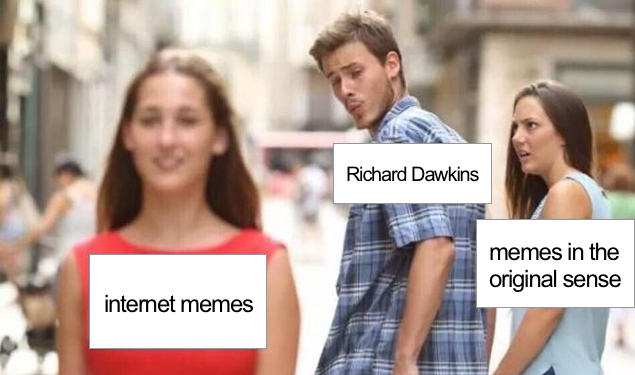
English evolutionary biologist Richard Dawkiwns coined the term ‘meme’ in his 1976 book, the Selfish Gene. He proposed a compelling idea in the book: What if ideas behaved akin to living organism, breeding, mutating, and waging a battle for survival within our mind to make a strong impact, imprint or impression? He envisioned these cerebral nations as cultural genes, birthing in the cradle of the mind and traversing far and wide, vying for attention.

He first thought of using the term mimeme, derived from the Greek word denoting “That which is replicated,” intending to describe these replicating ideas. However, he later condensed the term to “meme,” favouring its brevity and its phonetic resemblance to “gene.” He invited a pronunciation similar to “cream,” aiming to unify its sound with the concept of gene.

As language is ever-changing…

Over time, the meaning of “meme” evolved significantly. In today’s context, particularly within the vast realms of the internet, meme refer to pieces of media-images, videos, or phrases- repurposed to convey cultural, social, or political messages, usually employing humour as a tool for expression.

They often convey inside jokes, political satire, social commentary, or simply aim to amuse and entertain audiences worldwide. Moreover, memes operate within a collaborative social framework; their meanings and impact are co-created by multiple users.

Today, memes don’t just exist; they breathe, mutate, and thrive in a collective symphony. Their essence morphs and remixes across digital communities, a collaboration shaping their meaning and impact.

Tardar sauce (pictured here) became an internet celebrity nicknamed grumpy cat after its owner shared its picture on Reddit in 2012. The cat had feline dwarfism and an underbite, which gave her an unusual face. The grumpy cat’s face has become a pop culture staple and spawned many memes and merchandise.

Picture Credit : Google

What are sand dollars?

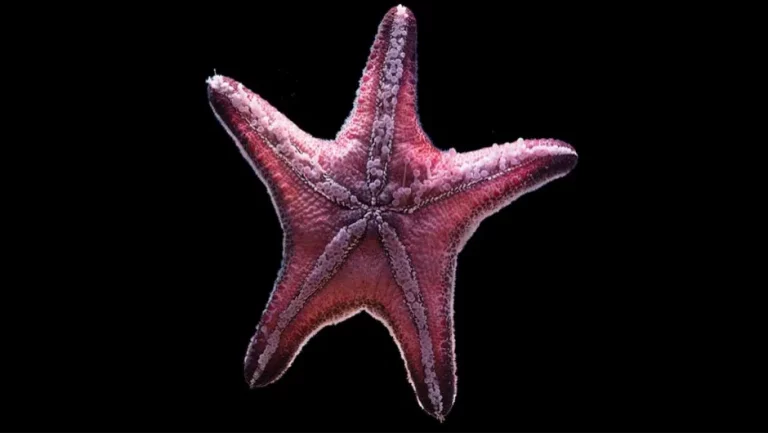
When alive, they look like huge coins with their flat, disk-shaped body. But mostly you would come across them when they have deceased. You might notice these patterned white shells in the sand. These star-stamped skeletons (tests) are much sought-after by beachcombers. (But let us warn you, it is never advised to pick up these creatures, dead or alive). Meet sand dollars, the bottom-dwelling creatures in the ocean.

Also called sea biscuits or sand cakes, the sand dollars belong to the order Clypeastroida. They are close relatives of sea urchins and heart urchins and are adapted to burrow themselves in sandy substrates. They dwell in the tropical and temperate waters throughout the Northern Hemisphere. Measuring from 5 to 10 cm in diameter, the sand dollars are invertebrates belonging to the class of marine animals known as echinoids. They have a radiating arrangement of parts.

The holes in their skeleton are what you notice first. But these aren’t there just for design sake. Arranged in a unique petal fashion these sets of gas-and water-processing pores are called lunules and act as pressure drainage channels.

The upper surface of their body showcases what is called pentaradiate (five-fold) symmetry From its centre, a pattern of five “petals” spread out. The mouth of this unique creature is located at the centre of its body’s underside.

While alive, the sand dollars have bristles known as spines which even cover their star design and they appear in hues ranging from reddish-brown to purple. When they die, these skeletons turn white, bleached by the sun, which is how you may often find them on the beach.

They breathe through the “petaloids”, a set of tiny holes in the skeleton. They live in the sand, using their spines to burrow into the sand. If the water is still, they can be seen standing upright, with one of their ends buried in the sand and they lie down or burrow themselves under the sand if the waters get rough.

Adult sand dollars live on the sea floor while the larva (also called pluteus) floats among the ocean’s planktons. The juveniles are seen in the subtidal zones while the adult sand dollars live in the intertidal zone.

Some of the threats these creatures face include bottom trawling, ocean acidification, climate change and so on. It is illegal to remove the sand dollars in most regions. Why we suggest that you should never pick them up is that you may not know if they are dead or alive. They can survive out of water for only a few minutes.

TRIVIA

* Sand dollars use their spines to eat. They feed on small food particles in the sand and are said to take two whole days to digest food.

* The creature gets its name from the resemblance it has to dollar coins. Other names include “sand cake,” “sea biscuit,” “cake urchin,” “pansy shell”, “sea cookie” and so on.

* A sand dollars age can be ascertained by the number of rings it sports on the plates of the creature’s test. As they grow, the number of rings increases.

* The larva of the sand dollar splits itself into two identical clones to hide from predators.

* The mouth of a sand dollar is called Aristotle’s lantern.

Picture Credit : Google

Why isn’t there an sound in space?

“In space, no one can hear you scream.” You may have heard this saying. It’s the tag line from the famous 1979 science fiction movie “Alien.” It’s a scary thought, but is it true? The simple answer is yes, no one can hear you scream in space because there is no sound or echo in space. I’m a professor of astronomy, which means I study space and how it works. Space is silent – for the most part.

How sound works

To understand why there’s no sound in space, first consider how sound works. Sound is a wave of energy that moves through a solid, a liquid or a gas. Sound is a compression wave. The energy created when your vocal cords vibrate slightly compresses the air in your throat, and the compressed energy travels outward.

A good analogy for sound is a slinky toy. If you stretch out a Slinky and push hard on one end, a compression wave travels down the Slinky. When you talk, your vocal cords vibrate. They jostle air molecules in your throat above your vocal cords, which in turn jostle or bump into their neighbours, causing a sound to come out of your mouth.

Sound moves through air the same way it moves through your throat. Air molecules near your mouth bump into their neighbours, which in turn bump into their neighbours, and the sound moves through the air. The sound wave travels quickly, about 1,223 kilometres per hour, which is faster than a commercial jet

 Sound in the solar system

Scientists have wondered how human voices would sound on our nearest neighbouring planets. Venus and Mars. This experiment is hypothetical because Mars is usually below freezing, and its atmosphere is thin. unbreathable carbon dioxide. Venus is even worse – its air is hot enough to melt lead, with a thick carbon dioxide atmosphere.

On Mars, your voice would sound tinny and hollow, like the sound of a piccolo On Venus, the pitch of your voice would be much deeper, like the sound of a booming bass guitar.The reason is the thickness of the atmosphere. On mars the thin air creates a high-pitched sound,and on venus the thick air creates a low-pitched sound. The team that worked this out simulated other solar system sounds, like waterfall on saturn’s moon titan.

Deep space sounds

While space is a good enough vacuum that normal sound can’t travel through it, it’s actually not a perfect vacuum, and it does have some particles floating through it. Beyond the Earth and its atmosphere, there are five particles in a typical cubic centimetre – the volume of a sugar cube- that are mostly hydrogen atoms.

By contrast, the air you are breathing is 10 billion billion (1019) times more dense. The density goes down with distance from the Sun, and in the space between stars there are 0.1 particles per cubic centimetre. In vast voids between galaxies, it is a million times lower still fantastically empty.

The voids of space are kept very hot by radiation from stars. The very spread-out matter found there is in a physical state called a plasma. A plasma is a gas in which electrons are separated from protons. In a plasma, the physics of sound waves get complicated. Waves travel much faster in this low-density medium, and their wavelength is much longer.

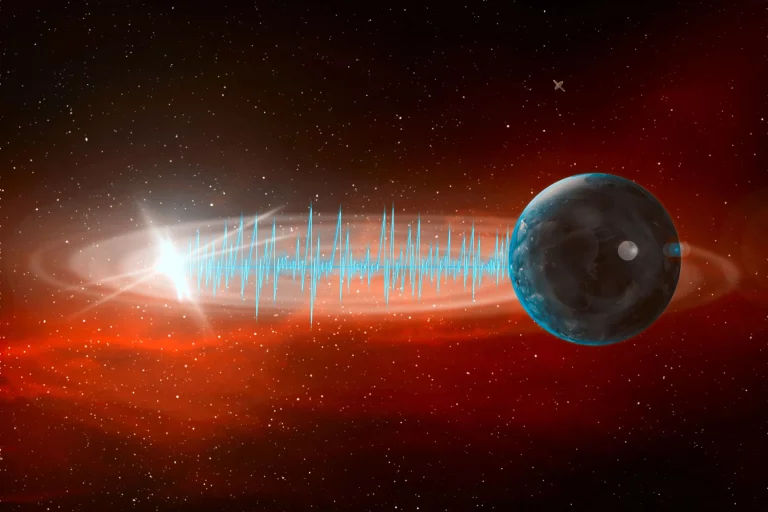
In 2022, NASA released a spectacular example of sound in space. It used X-ray data to make an audible recording that represents the way a massive black hole stirs up plasma in the Perseus galaxy cluster, 250 million light years from Earth. The black hole itself emits no sound, but the diffuse plasma around it carries very long wavelength sound waves.

The natural sound is far too low a frequency for the human ear to hear, 57 octaves below middle C which is the middle note on a piano middle of the range of sound people can hear. But after raising the frequency to the audible range, the result is chilling – it’s the sound of a black hole growling in deep space.

Space is a vacuum

So what about in space? Space is a vacuum, which means it contains almost no matter. The word vacuum comes from the Latin word for empty. Sound is carried by atoms and molecules, In space, with no atoms or molecules to carry a sound wave, there’s no sound. There’s nothing to get in sound’s way out in space, but there’s nothing to carry it, so it doesn’t travel at all. No sound also means no echo. An echo happens when a sound wave hits a hard, flat surface and bounces back in the direction it came from By the way, if you were caught in space outside your spacecraft with no spacesuit, the fact that no one could hear your cry for help is the least of your problems. Any air you still had in your lungs would expand because it was at higher pressure than the vacuum outside. Your lungs would rupture. In a mere 10 to 15 seconds, you’d be unconscious due to a lack of oxygen.

Picture Credit : Google

What makes country Georgia special?

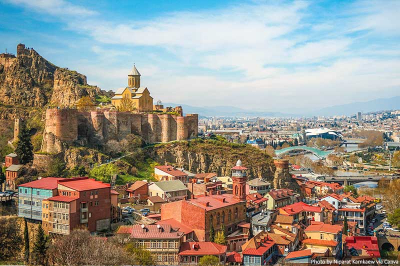
Georgia is a country located at the crossroads of Eastern Europe and Western Asia. It is part of the Caucasus region, bound by the Black Sea, with Russia. Armenia, and Azerbaijan as its neighbouring countries. Even though it is quite small, the country has a lot to offer. It boasts of ancient cities, vibrant culture, and breathtaking landscapes. It is also referred to as ‘Sakartvelo’, as Georgians call themselves Kartavelians- meaning “land where Kartavelis Live”.

The Georgian kingdom has been under the hegemony of various regional powers, including the Mongols, the Ottoman Empire, and various dynasties of Persia. It was later invaded and annexed by the Soviet Union until the country got its independence in the early 1990s. Tbilisi is the current capital and largest city. It gets its name from an old Georgian word “tbili” which means “warm”. This old town features narrow streets and a variety of architectural styles, reflecting the influences of the various empires. making it feel like a journey through time. Most of the architecture consists of churches. monasteries with fine metalwork representing the Byzantine style

Georgian is the official language spoken, which is one of the oldest languages in the world. Strongly influenced by the Greek and Persian, Georgian evolved around 5th century. The interesting fact about the language is that it does not use gender or capital letters. It has 33 alphabets, with many dialects. Other Caucasian languages are also spoken in minority.

Picture Credit : Google

How do crystals form?

Rocks are mixtures of different minerals. All minerals are crystals, but not all crystals are minerals. These solid substances are found naturally in the ground. But do we know how they are formed?

How do crystals form?

Scientifically speaking, the term “crystal” refers to any solid that has an ordered chemical structure. This means that its parts are arranged in a precisely ordered pattern, like bricks in a wall. The “bricks” can be cubes or more complex shapes. I’m an Earth scientist and a teacher, so I spend a lot of time thinking about minerals. These are solid substances that are found naturally in the ground and can’t be broken down further into different materials other than their constituent atoms. Rocks are mixtures of different minerals. All minerals are crystals, but not all crystals are minerals.

Most rock shops sell mineral crystals that occur in nature. One is pyrite, which is known as fool’s gold because it looks like real gold. Some shops also feature showy, human-made crystals such as bismuth, a natural element that forms crystals when it is melted and cooled.

Why and how crystals form

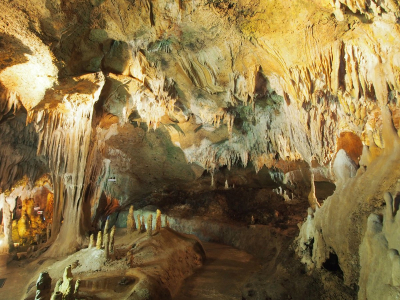
Crystals grow when molecules that are alike get close to each other and stick together, forming chemical bonds that act like Velcro between atoms. Mineral crystals cannot just start forming spontaneously – they need special conditions and a nucleation site to grow on. A nucleation site can be a rough edge of rock or a speck of dust that a molecule bumps into and sticks to, starting the crystallization chain reaction. At or near the Earth’s surface, many molecules are dissolved in water that flows through or over the ground. If there are enough molecules in the water that are alike, they will separate from the water as solids – a process called precipitation. If they have a nucleation site, they will stick to it and start to form crystals. Rock salt, which is actually a mineral called halite, grows this way. So does another mineral called travertine, which sometimes forms flat ledges in caves and around hot springs, where water causes chemical reactions between the rock and the air. You can make “salt stalactites” at home by growing salt crystals on a string. In this experiment, the string is the nucleation site. When you dissolve Epsom salts in water and lower a string into it, then leave it for several days, the water will slowly evaporate and leave the Epsom salts behind. As that happens, salt crystals precipitate out of the water and grow crystals on the string. Many places in the Earth’s crust are hot enough for rocks to melt into magma. As that magma cools down, mineral crystals grow from it, just like water freezing into ice cubes. These mineral crystals form at much higher temperatures than salt or travertine precipitating out of water.

What crystals can tell scientists

Earth scientists can learn a lot from different types of crystals. For example, the presence of certain mineral crystals in rocks can reveal the rocks’ age. This dating method is called geochronology – literally, measuring the age of materials from the Earth. One of the most valued mineral crystals for geochronologists is zircon, which is so durable that it quite literally stands the test of time. The oldest zircon ever found come from Australia and are about 4.3 billion years old – almost as old asour planet itself. Scientists use the chemical changes recorded within zircon as they grew as a reliable “clock” to figure out how old the rocks containing them are some crystals, including zircon, have growth rings, like the rings of a tree, that form when layers of molecules accumulate as the mineral grows. These rings can tell scientists all kinds of things about the environment in which they grew. For example, changesin pressure, temperature and magma composition can all result in growth rings. Sometimes mineral crystals grow as high pressure and temperatures within the Earth’s crust change rocks from one type to another in a process called metamorphism. This process causes the elements and chemical bonds in the rock to rearrange themselves into new crystal structures. Lots of spectacular crystals grow in this way, including garnet, kyanite and staurolite.

Amazing forms

When a mineral precipitates from water or crystallizes from magma, the more space it has to grow, the bigger it can become. There is a cave in Mexico full of giant gypsum crystals, some of which are 40 feet (12 meters) long – the size of telephone poles. Especially showy mineral crystals are also valuable as gemstones for jewellery once they are cut into new shapes and polished. The highest price ever paid for a gemstone was $71.2 million for the CTF Pink Star diamond, which went up for auction in 2017 and sold in less than five minutes. (The author works at University of Montana.) THE CONVERSATION

Picture credit : Google

What is the “wall of humanity”?

The Wall of Humanity' is a noble initiative where people leave their old clothes, toys, books, furniture and other usable household items near a designated wall which may later be collected by the needy. The concept originated in Iran in 2015. At the time, Iran's economy was in bad shape and people with limited means were finding it tough to deal with the harsh Iranian winter. That's when some youths in the city of Mashhad came up with the idea of helping the poor in a manner which would not make them feel embarrassed.

"Leave what you don't need, take what you do"

They began to hang their old clothes on the city walls and it soon became a trend known as 'Deewar-e-Meherbani. A similar campaign was started in Pakistan by a young boy, which came to known as 'Deewar-e-Insaniyat. It included donations of food, clothes, medicines and books for the needy.

In India this concept first immerged in form of 'Neki ki Deewar in Bhilwara, Rajasthan. Today, similar such walls of humanity have sprung up in dozens of Indian cities including Mumbai, Chandigarh, Mysore, Allahabad, Pune, Nagpur, Nashik, Aurangabad, Bhopal.  

Picture Credit : Google